Building a shed yourself costs between $1,500 and $8,000 in materials depending on size, style, and the finishes you choose. Hiring a contractor to build the same shed adds 30–50% on top of that. Buying a pre-built shed from a dealer costs even more — often two to three times what you’d spend doing it yourself with quality materials.
The wide cost range isn’t vague — it reflects real variables: a 6×8 lean-to with a gravel foundation and basic siding is a fundamentally different project than a 16×20 barn shed with a concrete slab, insulation, and a loft. This guide breaks down every cost factor so you can put together an accurate budget for your specific build before you buy a single board.
All estimates below are based on current lumber and material pricing at major US retailers including Home Depot and Lowe’s. Lumber prices fluctuate, so treat these as solid planning numbers rather than exact quotes — check current prices at your local store before finalizing your materials list.
Quick Answer: Shed Cost by Size
The table below shows realistic DIY material costs and estimated contractor totals for the most common shed sizes. DIY costs cover materials only — your labor is free. Contractor totals include both materials and labor.
| Shed Size | Square Footage | DIY Material Cost | Contractor Total |
|---|---|---|---|
| 6×8 | 48 sq ft | $800 – $1,500 | $2,000 – $3,500 |
| 8×10 | 80 sq ft | $1,500 – $2,500 | $3,000 – $5,000 |
| 10×12 | 120 sq ft | $2,500 – $4,000 | $4,500 – $7,000 |
| 12×16 | 192 sq ft | $4,000 – $6,500 | $7,000 – $12,000 |
| 16×20 | 320 sq ft | $6,000 – $10,000 | $10,000 – $18,000 |
These figures assume a standard wood-frame shed with pressure-treated floor joists, T1-11 plywood siding, asphalt shingle roofing, a gravel pad foundation, and a single pre-hung door. Adding windows, electrical, insulation, or a higher-grade siding material will push costs toward the top of each range or beyond it.
What Drives the Cost of a Shed?
Most people underestimate shed costs because they think only about lumber. In reality, framing lumber makes up roughly 30–40% of total material cost. The rest is foundation, siding, roofing, hardware, doors, windows, and paint — each of which can vary significantly depending on what you choose. Here’s how each factor breaks down.
1. Size
Shed size is the single biggest cost driver, and the relationship isn’t linear — it’s closer to exponential. Going from an 8×10 to a 10×12 adds 40 square feet of floor area, but it also means more wall framing, more siding panels, more roofing material, more floor decking, and a larger foundation. The additional material cost for that size jump typically runs $800–$1,500 depending on material choices.
Going from a 10×12 to a 12×16 is an even bigger jump — you’re adding 72 square feet of floor space and proportionally more of everything. This is why it’s important to be realistic about what size you actually need rather than defaulting to the largest shed that fits your yard. A well-organized 10×12 stores more than a cluttered 12×16, and it costs significantly less to build. Our shed sizing guide (coming soon) walks through how to match size to actual use case.
2. Foundation Type
Your foundation choice has a significant impact on both cost and complexity. It also affects whether you need a building permit in many jurisdictions — sheds on permanent foundations like concrete slabs are more likely to trigger permit requirements than sheds on non-permanent foundations like gravel pads or skids.
- Gravel pad with pressure-treated skids: $100–$400. This is the most common and most affordable foundation for sheds under 12×16. You excavate a few inches, lay landscape fabric, fill with compacted gravel, and set 4×4 or 4×6 pressure-treated skids on top. It’s not permanent, drains well, and works on most soil types. Most of our shed plans are designed for this foundation type.
- Concrete deck blocks or pier blocks: $300–$800. Precast concrete blocks set at each corner and mid-span provide a more stable base than skids alone, especially on uneven ground. This is a good middle-ground option for larger sheds where you want more support without pouring a full slab. Still considered non-permanent in most jurisdictions.
- Poured concrete slab: $800–$2,500+. The most permanent and most expensive option. Required by some building departments for larger sheds or sheds with electrical service. A concrete slab makes sense for a dedicated workshop where you’ll be rolling heavy equipment or standing on the floor for long periods. For a standard storage shed, it’s usually overkill.
For most standard storage sheds under 12×16, a gravel pad with pressure-treated skids is the right call — it’s affordable, drains well, and is accepted by the majority of building departments. See our permit guide for how foundation type affects permit requirements in your area.
3. Siding Material
Siding is one of the most visible cost variables in a shed build, and it affects both the upfront cost and how much maintenance the shed requires over time. The three most common options for DIY shed builders are:
- T1-11 plywood siding: $1.50–$2.50 per sq ft. The default choice for most DIY shed plans, including all of the plans on this site. T1-11 is a structural plywood panel with grooves routed into the face to mimic board-and-batten siding. It goes up fast, provides both sheathing and siding in one panel, and costs significantly less than other options. Properly primed and painted, it holds up well for 15–20+ years. Requires repainting every 5–7 years in most climates.
- LP SmartSide engineered siding: $2.50–$4.00 per sq ft. An engineered wood product treated for moisture and impact resistance. More durable than standard T1-11, holds paint longer, and is less prone to swelling and delamination in wet climates. A good upgrade choice if you’re building in the Pacific Northwest, Florida, or anywhere with heavy rainfall.
- Cedar or redwood boards: $4.00–$7.00 per sq ft. The premium option. Cedar naturally resists rot and insects, weathers beautifully, and looks significantly better than plywood siding. The cost is substantially higher, and installation takes longer since you’re applying individual boards rather than full panels. Best suited for sheds that will be prominently visible in a backyard where aesthetics matter.
4. Roofing
Roofing materials typically account for $250–$600 of the total build cost on a standard shed, depending on shed size and material choice. The most common options are:
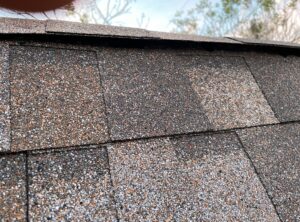
- 3-tab asphalt shingles: $80–$120 per square (100 sq ft). The standard for most DIY sheds. Widely available, easy to install, and compatible with any roof pitch above 3:12. A typical 10×12 shed with a standard gable roof needs about 2–3 squares. Lifespan of 15–25 years with proper installation.
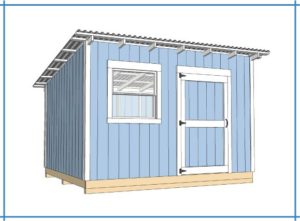
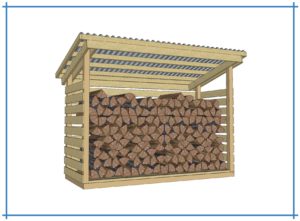
- Metal roofing panels: $150–$300 per square. Corrugated or standing-seam metal panels last longer than shingles, are easier to install on low-pitch roofs, and require essentially no maintenance. The upfront cost is higher, but the lifespan (40–70 years) makes it cost-effective long-term. Particularly well-suited for lean-to sheds and firewood sheds where a low roof pitch makes shingles impractical.
- Cedar shingles or shakes: $250–$400 per square. The most expensive roofing option and the most visually distinctive. Cedar shingles pair particularly well with cedar board siding for a cohesive, premium look. Installation is more labor-intensive than either asphalt or metal roofing.
5. Doors and Windows
A standard single pre-hung exterior door — the type used on most storage sheds — costs $150–$400 depending on size and material. Double barn-style doors, which are common on larger sheds and workshop spaces, cost more: typically $300–$700 for a pre-built unit, or you can build them yourself from lumber for $100–$200 following the door plans included in most of our shed plan sets.
Windows add both cost and natural light. A standard single-pane shed window runs $80–$150. A double-pane vinyl window costs $150–$250. If you’re sourcing windows on a budget, Facebook Marketplace and architectural salvage stores regularly list double-pane windows in good condition for $20–$60 — they work perfectly in a shed even if they’re slightly irregular in size, since you frame the rough opening around whatever you have.
6. Labor (If Hiring Out)
If you hire a contractor or a handyman to build your shed, labor typically adds 30–50% on top of material costs. On a 10×12 shed with $3,000 in materials, that means a contractor total of $4,500–$6,500 all-in. On a larger 12×16 shed, the labor portion alone can run $3,000–$6,000 depending on your market and the contractor’s rates.
The good news is that shed building is genuinely achievable for a first-time DIYer with no prior construction experience. Our plans are written for all skill levels, the cuts are straightforward, and the framing follows the same basic principles regardless of shed size. Taking the project on yourself doesn’t just save money — it gives you full control over material quality and finish, and most people find the build process itself deeply satisfying.
DIY vs. Buying a Pre-Built Shed
Pre-built sheds sold through Home Depot, Lowe’s, local shed dealers, and companies like Tuff Shed are a convenient option — they’re delivered to your property and installed in a day. But that convenience comes at a steep premium. Pre-built sheds consistently cost two to three times more than building the same square footage yourself with quality materials.
The quality gap is real too. Pre-built sheds in the lower price ranges are often constructed with thinner wall framing (2×3 instead of 2×4), lower-grade siding, and lighter-duty roofing materials. A DIY shed built from our plans uses full 2×4 framing, structural-grade plywood, and standard roofing materials — the same construction methods used for home additions.
| Pre-Built Shed | DIY Build | |
|---|---|---|
| 8×10 shed | $3,500 – $6,000 | $1,500 – $2,500 |
| 12×16 shed | $8,000 – $14,000 | $4,000 – $6,500 |
| Customization | Limited options | Full control |
| Framing | Often 2×3 | Full 2×4 |
| Time to complete | Delivered in days | 1–3 weekends |
| Permit handling | Usually your responsibility | Your responsibility |
One thing pre-built sheds don’t solve: the permit. Regardless of whether you buy pre-built or build yourself, you’re still responsible for obtaining any required permits and ensuring the structure meets local setback requirements. The convenience of pre-built doesn’t extend to the regulatory side.
Real Project Cost Example: 12×10 Barn Shed
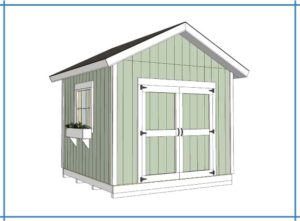
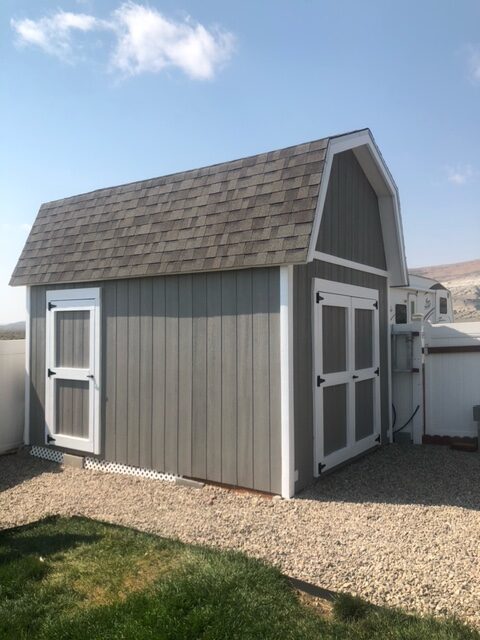
To make these numbers concrete, here’s a real material cost breakdown for our 12×10 Barn Shed — one of the most popular plans on this site. This assumes a gravel pad foundation, T1-11 siding, asphalt shingle roofing, and a single pre-hung door. Prices reflect current Home Depot pricing and will vary slightly by region.
| Item | Details | Estimated Cost |
|---|---|---|
| Framing lumber | 2×4s, 2×6 headers, pressure-treated floor joists | $600 – $900 |
| Floor decking | 23/32″ tongue-and-groove plywood, 4 sheets | $120 – $180 |
| T1-11 siding | 240 sq ft coverage, 5 panels | $400 – $600 |
| Roof sheathing | 1/2″ plywood, 240 sq ft | $180 – $260 |
| Roofing materials | Shingles, underlayment, drip edge | $200 – $320 |
| Foundation | Gravel, landscape fabric, 4×4 skids | $150 – $300 |
| Pre-hung door | Standard 36″ exterior door | $180 – $320 |
| Trim and fascia | Corner boards, fascia boards, drip cap | $80 – $150 |
| Hardware and fasteners | Screws, nails, joist hangers, hinges | $100 – $150 |
| Paint and primer | Exterior acrylic, 2–3 gallons | $80 – $130 |
| Total | $2,110 – $3,310 |
A comparable 12×10 barn shed from a shed dealer typically runs $5,500–$9,000 delivered and installed. The DIY savings on this specific build are $3,000–$6,000 — enough to buy a solid set of tools, cover the permit fee, and still have money left over.
How to Reduce Your Shed Build Cost
There are several legitimate ways to reduce the total cost of a shed build without compromising the structure. Here are the most effective ones.
Buy lumber in bulk and ask about contractor pricing. Home Depot and Lowe’s both have pro desks that handle bulk orders. If you’re buying enough lumber for a full shed frame, ask about contractor pricing or volume discounts — it’s not always advertised, but it’s often available. Buying all your lumber in one trip also saves multiple gas runs and reduces the chance of ending up with mismatched pieces from different batches.
Stick to standard dimensions throughout. All of our shed plans are designed around standard lumber lengths and plywood sheet sizes to minimize waste. A 4×8 plywood sheet that gets cut to an odd size generates expensive offcuts. Following the cut list exactly — rather than improvising dimensions — keeps your waste close to zero and your material cost down.
Choose a gravel foundation over concrete. A poured concrete slab for a 10×12 shed costs $800–$2,000 and requires either renting equipment or hiring someone to pour it. A properly built gravel pad with pressure-treated skids costs $150–$400, is faster to install, and works perfectly for the vast majority of residential shed applications. Unless your building department requires a slab or you’re building a heavy-equipment workshop, skip the concrete.
Source windows and doors secondhand. Windows are one of the easiest places to find quality materials at a fraction of retail cost. Facebook Marketplace, Craigslist, and local Habitat for Humanity ReStore locations regularly have vinyl double-pane windows for $20–$60 each. You frame the rough opening around whatever size you find, so exact dimensions don’t matter as long as the window fits the wall height.
Paint it yourself. Professional exterior painting on a shed runs $400–$800 in most markets. Painting a shed is straightforward — clean the surface, apply a coat of exterior primer, let it dry, and roll on two coats of exterior acrylic. A quality roller, a brush for corners, and three gallons of paint costs about $80–$130 and takes a Saturday afternoon. The result is indistinguishable from a professional paint job on a flat surface like shed siding.
Time your lumber purchase. Lumber prices fluctuate seasonally and with broader economic conditions. If you’re not in a rush, watching prices for a few weeks and buying during a dip can save 10–20% on your total lumber spend — which on a 12×16 shed could be several hundred dollars.
Frequently Asked Questions
How much does it cost to build a 10×12 shed?
A 10×12 shed built with standard materials — 2×4 wood framing, pressure-treated floor joists, T1-11 siding, asphalt shingles, and a gravel foundation — costs between $2,500 and $4,000 in materials. If you hire a contractor to build it, expect a total of $4,500–$7,000 including labor. A pre-built 10×12 shed from a dealer typically runs $5,500–$9,000 delivered. The DIY material savings over buying pre-built range from $1,500 to $5,000 depending on options.
Is it cheaper to build or buy a shed?
Building a shed yourself is significantly cheaper than buying pre-built in virtually every scenario. The savings are most dramatic on larger sheds — on a 12×16 shed, DIY material costs run $4,000–$6,500 compared to $8,000–$14,000 for a comparable pre-built unit. Even on a small 8×10 shed, the DIY material cost of $1,500–$2,500 compares favorably to a pre-built price of $3,500–$6,000. The trade-off is time: expect to spend 2–3 weekends building rather than waiting a few days for delivery.
How long does it take to build a shed?
A first-time builder working with a partner can typically complete an 8×10 or 10×12 shed in 2–3 weekends. The foundation and floor frame take one day. Wall framing and raising takes another. Roof framing and sheathing is a third day. Siding, roofing, trim, and painting spread across the remaining time. Larger sheds — 12×16 and up — realistically take 3–5 weekends for two people working at a comfortable pace. Working alone adds time to each stage, particularly for wall raising and roof sheathing, where a second pair of hands makes a real difference.
How much does a shed foundation cost?
Foundation cost depends heavily on type. A gravel pad with pressure-treated skids — the most common choice for residential sheds — costs $150–$400 depending on shed size and how much gravel you need. Concrete deck block piers run $300–$800 and provide more stability on uneven ground. A poured concrete slab is the most expensive option at $800–$2,500 or more, and typically requires professional installation. For most sheds under 12×16, a gravel pad foundation is sufficient and the most cost-effective choice.
What is the most affordable shed to build?
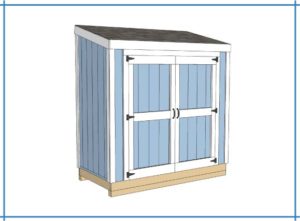
A lean-to shed is the most affordable structure you can build from scratch. The single-slope roof is simpler to frame than a gable or gambrel roof, the wall height on one side can be lower, and the overall footprint is smaller. Our 4×8 Lean-To Shed Plans can be built for under $500 in materials and completed in a single weekend. A firewood shed is similarly affordable — designed to be open on the front, which eliminates door costs and simplifies construction.
Do I need a permit to build a shed, and does that cost money?
Whether you need a permit depends on your county and the size of the shed. Most jurisdictions exempt sheds under 100–120 square feet from permitting requirements, but rules vary significantly. Where permits are required, they typically cost $50–$200. The permit process usually involves submitting a site plan and shed drawings — our full PDF plans include the framing plans, elevations, and materials list that most building departments require. For a complete breakdown of how permit requirements work and how to check your specific county, see our full permit guide.
Ready to Start Building?
Now that you have a clear picture of what your build will cost, the next step is picking the right plan. Every plan on this site includes a complete materials list, cut list, 2D framing plans, 3D diagrams, and step-by-step assembly instructions — so your first trip to the lumber yard is organized and efficient rather than a guessing game.